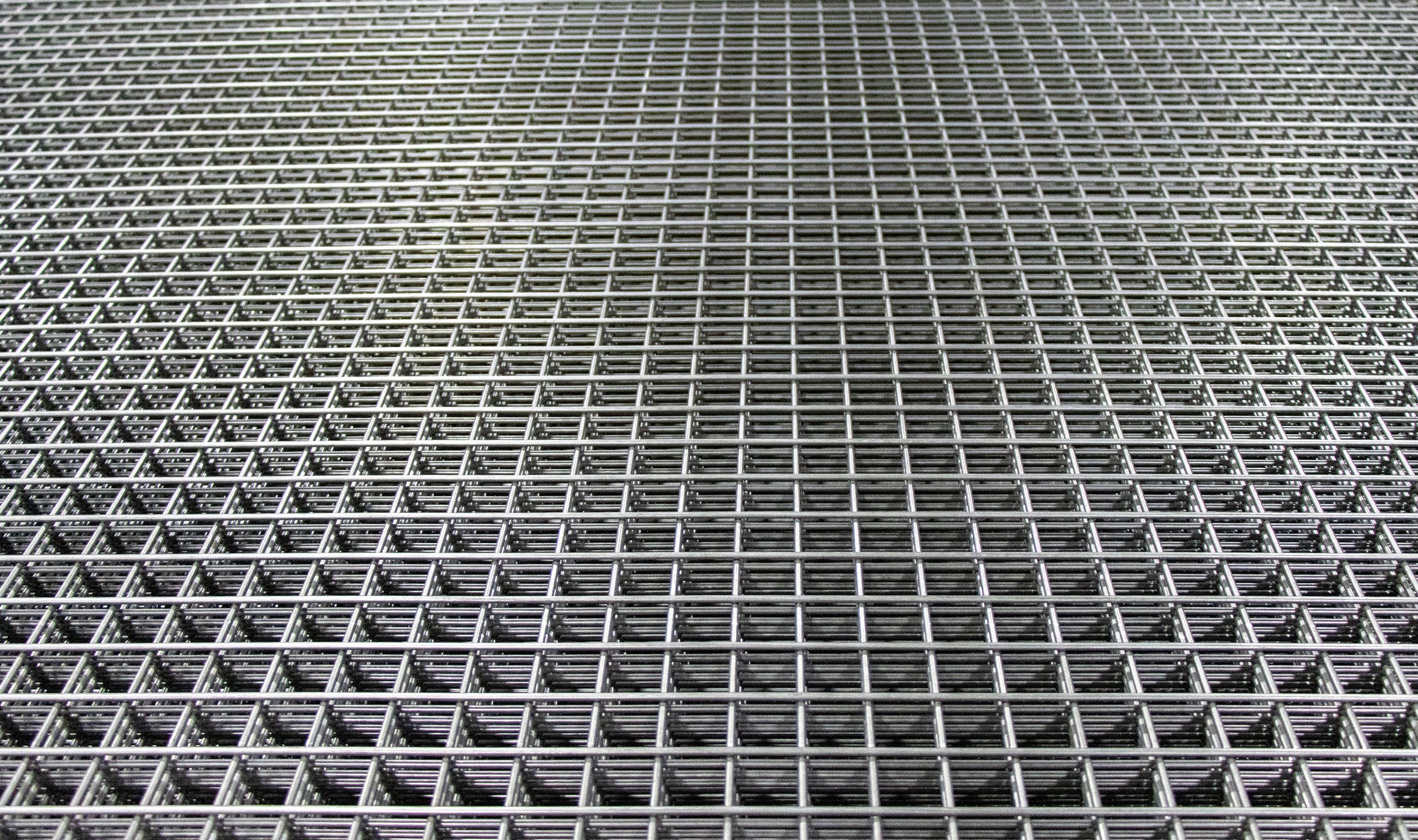
Q335 Reinforcing Steel Mesh
Square (Q-type) welded fabric with 8 mm longitudinal and transverse wires at 150 mm pitch — delivering approximately 3.35 cm²/m cross-section in both directions. Manufactured to DIN 488-4 and EN 10080, Q335 is one of the most widely specified mesh grades for suspended slabs, floor plates, and precast panels across residential and commercial construction.
Q335 Mesh: Technical Specification
Q335 is a square (Q) welded mesh conforming to DIN 488-4 in which the designation “335” encodes the steel cross-section per metre: 3.35 cm²/m (335 mm²/m) in both the longitudinal and transverse directions simultaneously. The wire diameter is nominally 8.0 mm at 150 mm pitch in each direction.
Using the standard weight formula (kg/m = d² × 0.00617), a single 8 mm wire weighs 0.395 kg/m. Accounting for both wire directions, Q335 has an approximate sheet weight of 5.93 kg/m² — a useful figure for estimating crane loads and freight tonnage when ordering by sheet area.
Standard panel size is approximately 6.0 × 2.3 m. Steel grade is B500A or B500B to EN 10080, with all wire-to-wire intersections joined by resistance welding. Q335 is the step up from Q257 and remains lighter than Q424, making it the default “standard mesh” in many European building codes and contractors’ procurement schedules.
Dimensional and Weight Summary
| Parameter | Value |
|---|---|
| Wire diameter (longitudinal & transverse) | 8.0 mm (nominal) |
| Wire pitch (both directions) | 150 mm |
| Cross-section per metre (As) | ≈ 3.35 cm²/m (335 mm²/m) |
| Approx. sheet weight | ≈ 5.93 kg/m² |
| Standard sheet size | 6.0 × 2.3 m (13.8 m²/sheet) |
| Steel grade | B500A / B500B to EN 10080 |
| Standard | DIN 488-4, EN 10080 |
| Weld type | Electrical resistance welding |
Where Q335 Mesh Is Specified
Common structural and architectural applications for Q335 welded fabric.
Suspended Concrete Slabs
Q335 is the most common minimum mesh for suspended one-way and flat-slab floors in residential and light commercial buildings, satisfying Eurocode 2 minimum reinforcement ratios for 200 mm slabs.
Basement Slabs & Raft Foundations
Lightly to moderately loaded raft foundations benefit from Q335 as the bottom layer mesh for ground pressure distribution and shrinkage crack control.
Roads & Hardstandings
Industrial pavements, logistics yards, and access roads regularly use Q335 as a mid-slab crack-distributing layer, replacing loose bar arrangements with consistent coverage.
Infrastructure →Precast Concrete Elements
Precast wall panels, stair flights, and filigree lattice-slab toppings frequently specify Q335 as the face or topping mesh. Its balance of steel area and sheet weight suits high-throughput precast production.
Precast →Retaining Walls
Secondary horizontal reinforcement in cast-in-situ retaining walls is often specified as Q335, supplementing the primary vertical bar cage for temperature and shrinkage control.
High-Rise Core Walls
In high-rise shear cores, Q335 mesh is used as the horizontal tie reinforcement within wall panels, speeding placement compared with individually tied horizontal bars.
High-Rise →Standards, Conformity, and Export Documentation
Q335 mesh is manufactured to DIN 488-4 and the harmonised European standard EN 10080. The underlying wire is produced in grade B500A or B500B — both with 500 MPa minimum characteristic yield strength — with ductility classes as defined in EN 10080 and referenced by Eurocode 2 (EN 1992-1-1).
All shipments from Steel Rebar Germany are accompanied by an EN 10204 Type 3.1 Mill Test Certificate, which provides heat-traceable chemical and mechanical data. For export to markets outside the EU, we additionally prepare:
- Certificate of Origin (notarised or chamber-stamped as required by the destination customs authority)
- CE Declaration of Performance referencing EN 10080 / Annex ZA
- Packing list with bundle count, sheet count per bundle, gross/net weights, and container load plan
- Seaworthy bundling — moisture-inhibiting wrapping, wire bindings, suitable for full container or break-bulk ocean freight
Buyers working with national equivalents to EN 10080 (e.g. BS 4449, ASTM A1064, ISO 6935-2) should ask their structural engineer to verify comparability. We can supply the relevant MTC data and product data sheets to support this review.
Standards & Certification → Export & Delivery →Compare Q-Type Mesh Grades
Select the right square mesh cross-section for your structural design requirement.
| Grade | Wire Dia (mm) | Pitch (mm) | As (cm²/m) | Approx. Weight (kg/m²) |
|---|---|---|---|---|
| Q257 | 7.0 | 150 | 2.57 | ≈ 4.50 |
| Q335 (this page) | 8.0 | 150 | 3.35 | ≈ 5.93 |
| Q424 | 9.0 | 150 | 4.24 | ≈ 7.51 |
| Q524 | 10.0 | 150 | 5.24 | ≈ 9.27 |
| Q636 | 9.0 | 100 | 6.36 | ≈ 11.25 |
All grades to DIN 488-4 / EN 10080. See the full mesh sizes guide and the mesh overview page →
Frequently Asked Questions — Q335 Mesh
Why is Q335 described as the “standard mesh” for suspended slabs?
Can Q335 be used as top and bottom mesh simultaneously?
What is the difference between B500A and B500B for Q335?
What minimum order quantity applies for Q335?
Does Q335 mesh comply with Eurocode 2 design rules?
Source German-standard rebar with full export documentation
Tell us your Q335 mesh requirement and destination port — we’ll respond with a detailed quotation.
