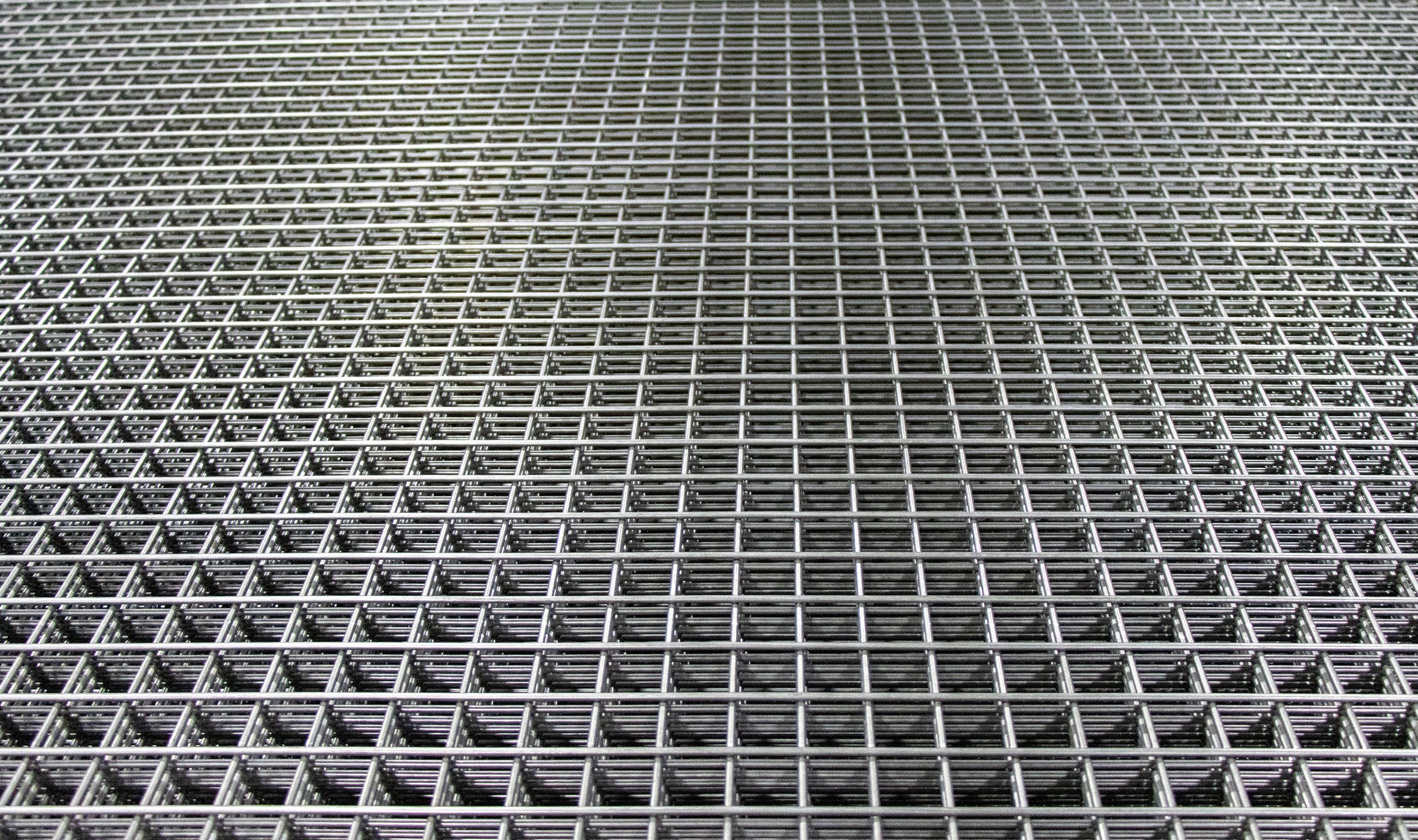
Q636 Reinforcing Steel Mesh
Square (Q-type) welded fabric with 9 mm wires at 100 mm pitch — delivering approximately 6.36 cm²/m cross-section in both directions. Manufactured to DIN 488-4 and EN 10080, Q636 provides the highest steel area in the standard DIN square mesh range, achieved through reduced wire pitch rather than larger diameter, offering superior crack-width control in heavily stressed structural elements.
Q636 Mesh: Technical Specification
Q636 occupies a unique position in the DIN 488-4 square mesh family: it achieves the highest standard cross-section — 6.36 cm²/m (636 mm²/m) — through a closer wire pitch of 100 mm rather than the 150 mm used by Q257 through Q524. The wire diameter is 9.0 mm, identical to Q424, but the tighter spacing gives 50% more wires per metre, raising the cross-section by 50% compared to Q424.
This closer pitch carries a specific structural benefit: Eurocode 2 Table 7.2 limits maximum bar spacing for crack-width control (typically 100–200 mm for wk ≤ 0.3 mm under moderate stress). Q636’s 100 mm pitch satisfies the most restrictive bar-spacing limits without requiring supplementary bars, making it the preferred mesh where crack width is the governing design criterion.
Using the weight formula (kg/m = d² × 0.00617), a 9 mm wire weighs 0.499 kg/m. Q636’s approximate sheet weight is 11.25 kg/m². Standard panel size: 6.0 × 2.3 m. Grade: B500A or B500B to EN 10080.
Dimensional and Weight Summary
| Parameter | Value |
|---|---|
| Wire diameter (longitudinal & transverse) | 9.0 mm (nominal) |
| Wire pitch (both directions) | 100 mm |
| Cross-section per metre (As) | ≈ 6.36 cm²/m (636 mm²/m) |
| Approx. sheet weight | ≈ 11.25 kg/m² |
| Standard sheet size | 6.0 × 2.3 m (13.8 m²/sheet) |
| Steel grade | B500A / B500B to EN 10080 |
| Standard | DIN 488-4, EN 10080 |
| Weld type | Electrical resistance welding |
| Key design advantage | 100 mm pitch satisfies EC2 Table 7.2 crack-width bar-spacing limits |
Where Q636 Mesh Is Specified
Applications where the 100 mm pitch and 6.36 cm²/m cross-section of Q636 are structurally decisive.
Water-Retaining Structures
Reservoirs, tanks, and water treatment basins are designed to crack-width limit wk ≤ 0.2 mm (BS EN 1992-3). Q636’s 100 mm pitch often achieves this without additional bars, reducing design complexity and site fixing time.
Bridge Decks — Severe Exposure
Exposure class XD3 / XS3 (chloride, de-icing salts) demands wk ≤ 0.3 mm or tighter. Q636 B500B is frequently the specified mesh for upper and lower layers in bridge decks, satisfying both the area and spacing requirements of EN 1992-2.
Infrastructure →Basement Walls — XC4/XD2 Exposure
Below-grade walls in contact with ground water or contaminated soils (exposure class XC4, XD2) benefit from Q636’s close spacing meeting crack-width targets without requiring separate secondary bar layers.
Foundations →Nuclear & Industrial Containment
Radiation shielding structures and secondary containment walls in industrial facilities frequently mandate both high As and close bar spacing for leak-tightness verification — Q636 satisfies both in a single mesh layer.
High-Rise Core Walls — Seismic
Coupled shear wall systems in high-seismic zones (DC Medium/High per EC8) require high horizontal reinforcement ratios with close spacing. Q636 B500B combined with confinement bars is used in boundary elements and coupling beams.
High-Rise →Tunnels & Cut-and-Cover Structures
Cast-in-situ tunnel linings and cut-and-cover box sections face combined bending, shear, and direct tension — Q636 provides the base reinforcement for the heavily reinforced outer cage.
Standards, Grade, and Export Documentation
Q636 is manufactured to DIN 488-4 and the harmonised European standard EN 10080. The 9 mm wire in grade B500B (high ductility, k ≥ 1.08, Agt ≥ 5.0%) is the most common specification, providing the ductility required by Eurocode 2 for structures where moment redistribution is assumed or where seismic ductility demand applies. Grade B500A (normal ductility) is also available for applications where the structural design permits.
The 100 mm wire pitch is a critical specification parameter — verify this with your structural engineer and material schedule before ordering, as confusion with Q424 (9 mm at 150 mm pitch) would produce an under-reinforced section. Our Mill Test Certificates explicitly state wire diameter, pitch, and As value for unambiguous traceability.
Export documentation from Steel Rebar Germany includes:
- EN 10204 Type 3.1 Mill Test Certificate — heat-traceable, with wire diameter, pitch, As, Re, Rm, Agt
- CE Declaration of Performance per EN 10080 / Annex ZA
- Certificate of Origin
- Packing list: bundle weights, sheet counts, container load plan
- Seaworthy packaging for ocean freight (wire-bound bundles, moisture-inhibiting wrapping)
Q-Type Mesh Comparison
Q636 in the DIN 488-4 square mesh family — the highest As, achieved via 100 mm pitch.
| Grade | Wire Dia (mm) | Pitch (mm) | As (cm²/m) | Approx. Weight (kg/m²) |
|---|---|---|---|---|
| Q257 | 7.0 | 150 | 2.57 | ≈ 4.50 |
| Q335 | 8.0 | 150 | 3.35 | ≈ 5.93 |
| Q424 | 9.0 | 150 | 4.24 | ≈ 7.51 |
| Q524 | 10.0 | 150 | 5.24 | ≈ 9.27 |
| Q636 (this page) | 9.0 | 100 | 6.36 | ≈ 11.25 |
All grades to DIN 488-4 / EN 10080. Full mesh sizes guide → | Mesh overview →
Frequently Asked Questions — Q636 Mesh
Why does Q636 use 9 mm wire at 100 mm pitch rather than a larger diameter at 150 mm?
What exposure classes and crack-width limits is Q636 typically designed for?
How does Q636 compare to Q524 for bridge deck applications?
Can Q636 be used in seismic design situations?
What should I check before substituting Q636 for Q524 in a reinforcement schedule?
Source German-standard rebar with full export documentation
Tell us your Q636 mesh specification and destination port — we’ll respond with a detailed quotation.
