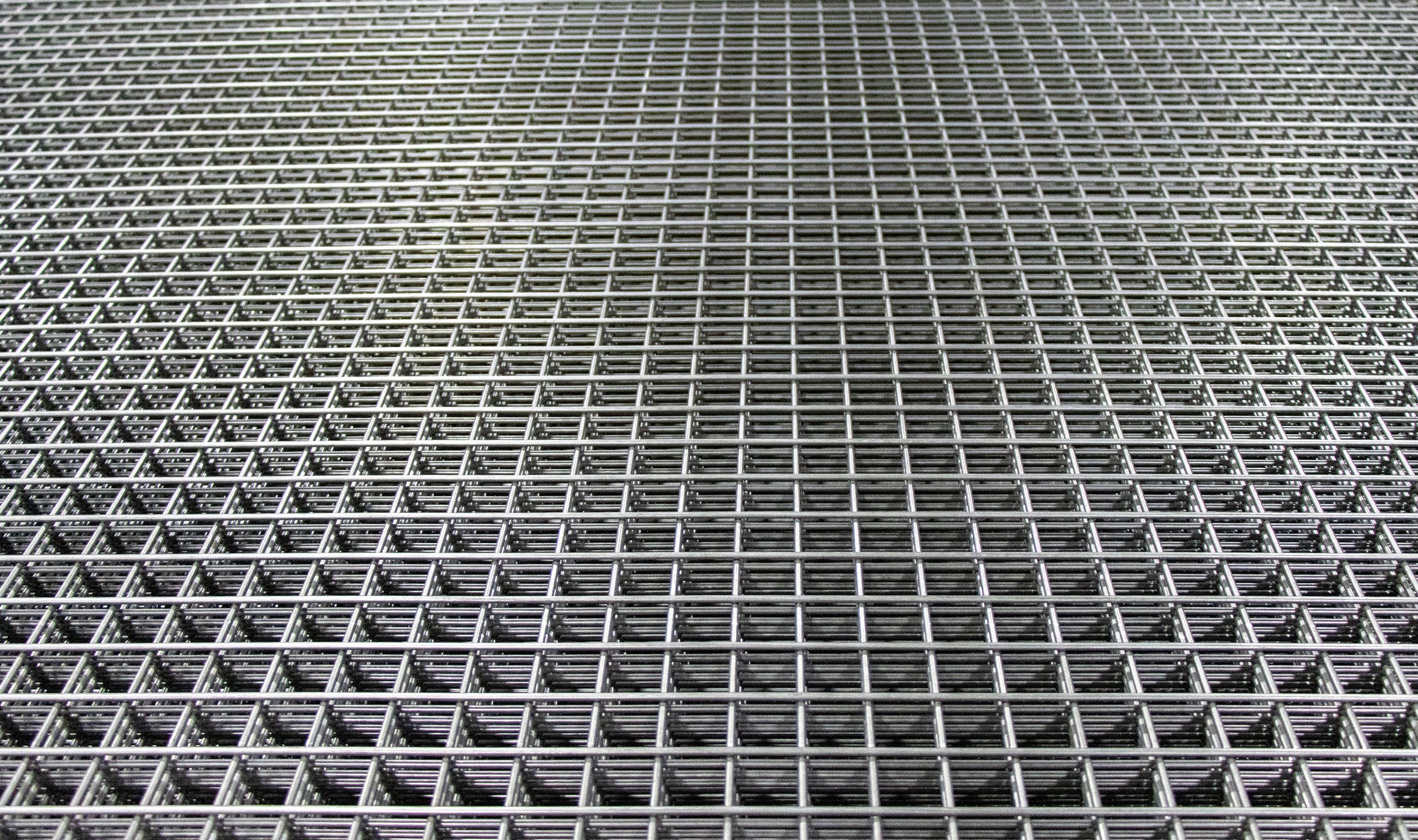
Q424 Reinforcing Steel Mesh
Square (Q-type) welded fabric with 9 mm wires at 150 mm pitch — providing approximately 4.24 cm²/m cross-section in both directions. Manufactured to DIN 488-4 and EN 10080, Q424 bridges the gap between standard slab mesh and heavily reinforced structural applications, making it a frequent choice for thicker suspended slabs, transfer plates, and heavily loaded ground floors.
Q424 Mesh: Technical Specification
Q424 is a square (Q) welded mesh to DIN 488-4 where “424” encodes the nominal cross-sectional area per metre: 4.24 cm²/m (424 mm²/m). Both longitudinal and transverse wires are nominally 9.0 mm in diameter at 150 mm pitch — the same pitch as Q257 and Q335, but the larger wire diameter delivers a 26% increase in steel area over Q335.
Using the standard formula (kg/m = d² × 0.00617), a 9 mm wire weighs 0.499 kg/m. The Q424 sheet weight is approximately 7.51 kg/m². Standard panel size is 6.0 × 2.3 m. Grade is B500A or B500B to EN 10080, resistance-welded at every intersection.
At 4.24 cm²/m, Q424 is well-suited to situations where the structural engineer requires reinforcement above the minimum ratio but below the step to closer-spaced or heavier grids — a frequent outcome in multi-storey commercial slabs and heavily loaded industrial floors.
Dimensional and Weight Summary
| Parameter | Value |
|---|---|
| Wire diameter (longitudinal & transverse) | 9.0 mm (nominal) |
| Wire pitch (both directions) | 150 mm |
| Cross-section per metre (As) | ≈ 4.24 cm²/m (424 mm²/m) |
| Approx. sheet weight | ≈ 7.51 kg/m² |
| Standard sheet size | 6.0 × 2.3 m (13.8 m²/sheet) |
| Steel grade | B500A / B500B to EN 10080 |
| Standard | DIN 488-4, EN 10080 |
| Weld type | Electrical resistance welding |
Applications for Q424 Welded Mesh
Where the extra cross-section of Q424 over standard mesh makes a structural or economic difference.
Thicker Suspended Slabs
Multi-storey commercial and mixed-use buildings with slab depths of 250–300 mm regularly require Q424 as the base mesh layer, satisfying higher minimum reinforcement ratios at greater effective depth.
Transfer Plates & Podium Slabs
Heavily loaded transfer structures benefit from Q424’s higher As as the distributed base reinforcement, with supplementary bars added in high-moment bands — reducing the total number of individual bars to fix.
Industrial Ground Floors
Warehouse and logistics centre slabs subject to heavy forklift and racking loads frequently specify Q424 as the crack-control layer, providing generous shrinkage and temperature reinforcement throughout the full slab area.
Foundations →Bridge Deck Soffits & Parapets
Secondary reinforcement in bridge deck slabs and parapet walls often requires a step above Q335 to comply with crack-width limits under traffic and environmental exposure — Q424 frequently meets this requirement.
Infrastructure →Precast Wall Panels
Thicker precast cladding and structural wall panels (200–300 mm) use Q424 as the face reinforcement layer, giving adequate cover depth and area without requiring a shift to loose bar arrangements.
Precast →Basement Retaining Walls
Deep basement walls in urban construction often specify Q424 at the exposed face for thermal and shrinkage crack control, combined with the designed structural bar arrangement on the retained-soil face.
Standards and Export Documentation for Q424
Q424 mesh is manufactured to DIN 488-4 (German reinforcing steel mesh) and the European harmonised standard EN 10080. Wire grade is B500A or B500B — both delivering a minimum characteristic yield strength of 500 MPa at the structural cross-section.
Every shipment from Steel Rebar Germany includes an EN 10204 Type 3.1 Mill Test Certificate traceable to the production heat, documenting chemical composition, tensile and ductility results, and dimensional checks. Full export documentation package:
- EN 10204 Type 3.1 Mill Test Certificate (chemical + mechanical, heat-traceable)
- CE Declaration of Performance per EN 10080 / Annex ZA
- Certificate of Origin (chamber or notarised, per destination requirements)
- Packing list: bundle dimensions, sheet counts, gross / net weights, container load plan
- Seaworthy packaging — wire-bound stacks, moisture-protective wrapping for ocean freight
Q-Type Mesh Comparison
Position Q424 within the full DIN 488-4 square mesh range.
| Grade | Wire Dia (mm) | Pitch (mm) | As (cm²/m) | Approx. Weight (kg/m²) |
|---|---|---|---|---|
| Q257 | 7.0 | 150 | 2.57 | ≈ 4.50 |
| Q335 | 8.0 | 150 | 3.35 | ≈ 5.93 |
| Q424 (this page) | 9.0 | 150 | 4.24 | ≈ 7.51 |
| Q524 | 10.0 | 150 | 5.24 | ≈ 9.27 |
| Q636 | 9.0 | 100 | 6.36 | ≈ 11.25 |
All grades to DIN 488-4 / EN 10080. Full mesh sizes guide → | Mesh overview →
Frequently Asked Questions — Q424 Mesh
What cross-section does Q424 provide and how does it differ from Q335?
Is Q424 suitable for use in seismic zones?
What welding standard applies to the mesh intersections in Q424?
Can Q424 sheets be overlapped in the same way as conventional mesh?
How is Q424 mesh priced — by tonne or by m²?
Source German-standard rebar with full export documentation
Tell us your Q424 mesh specification and destination port — we’ll respond with a detailed quotation.
